
- Case-study
Scoliosis Correction Surgery in an 11-Year-Old Boy withMarfan Syndrome
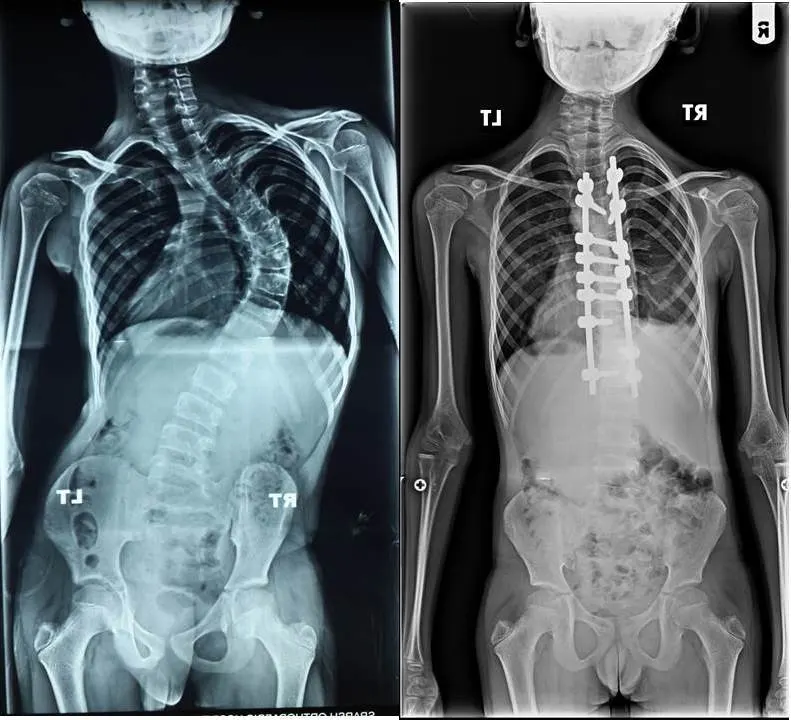
Patient Profile
| Age | 11 years |
| Gender | Male |
| Background | School-going child, resident of Davangere, Karnataka |
| Presenting Complaint | Progressing curvature of the spine over 2 years |
| Associated Features | Features suggestive of Marfan syndrome: tall slender build, long fingers, vision concerns |
| Diagnostic Method | Clinical assessment, standing spine X-rays, syndromic evaluation |
| Diagnosis | Severe scoliosis associated with Marfan syndrome |
| Treatment | Scoliosis correction surgery |
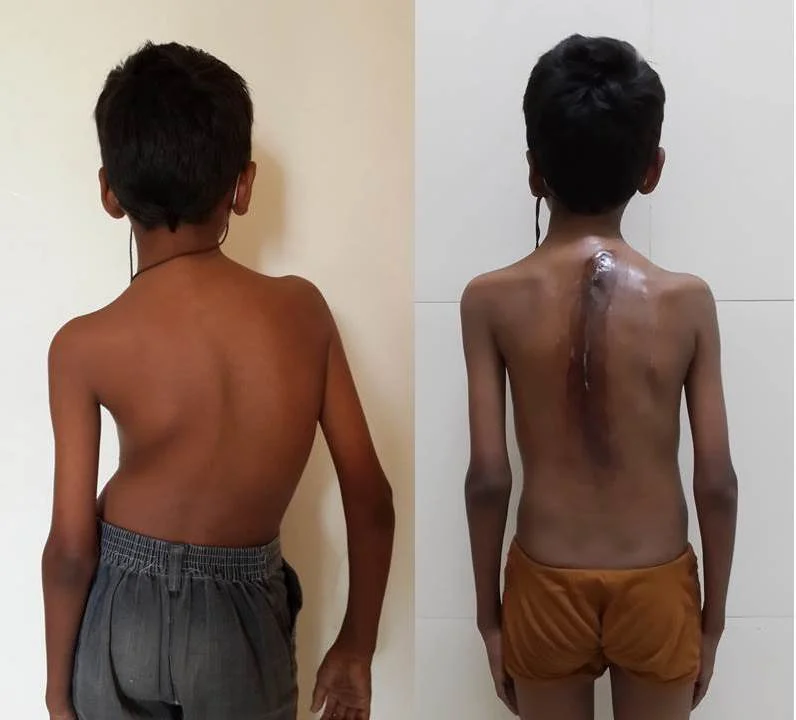
| Outcome | Curve corrected & spine stabilised; patient currently pursuing higher education |
Patient identity withheld per confidentiality guidelines
The Problem
Master A, an 11-year-old boy from Davangere, presented with a curve of the spine that had progressed over the previous two years. On evaluation, he showed features associated with Marfan syndrome, a genetic condition caused by a defect in collagen, a structural protein present in most tissues of the body. Children with Marfan syndrome typically have a tall, thin build, long slender fingers, vision problems, and sometimes heart valve or aortic involvement, along with a tendency toward scoliosis.
Because the underlying collagen defect affects the ligaments that support the spine, curves associated with Marfan syndrome can progress faster than typical idiopathic curves. Given the severity of the curve in this case, surgical correction was recommended.
About Syndromic Scoliosis and Marfan Syndrome (General Information)
Syndromic scoliosis refers to scoliosis that occurs as part of a wider genetic condition, such as Marfan syndrome, Ehlers-Danlos syndrome, or neurofibromatosis, rather than developing on its own. Since these conditions affect connective tissue throughout the body, planning needs to account for more than the spine alone.
Before surgery in a child with suspected Marfan syndrome, evaluation generally includes:
- A cardiac assessment, since Marfan syndrome can affect heart valves and the aortic wall
- An eye examination, to check for lens dislocation or other related findings
- Assessment of bone quality and ligament laxity, which affects how screws and rods are placed
- Assessment of remaining growth, to decide on the surgical approach
The aim is to correct and stabilise the curve while accounting for the connective tissue changes associated with the syndrome. Parents looking to understand scoliosis in general, including its causes and the range of treatment options, can find a broader overview on CureScoliosis.
Treatment Plan
Following evaluation, Dr. Naveen Tahasildar planned scoliosis correction surgery for Master A based on the severity and rate of progression of the curve. As with other children with a suspected syndromic cause, preparation included a cardiac and pulmonary check, nutrition review, and family counselling, in line with the standard pre-surgical process followed for such cases.
In Marfan-associated scoliosis, the treatment plan is generally guided by the degree of curvature, the child’s remaining growth, and the condition of the bone and ligaments, which determine how the rods and screws are positioned.
Procedure
The treatment carried out for Master A was scoliosis correction surgery, performed by Dr. Naveen Tahasildar.
How Scoliosis Correction Surgery Is Generally Performed
In general, correction surgery for a severe syndromic curve follows this sequence:
Outcome
Outcomes at a Glance
Long-Term Expectation
The long-term expectation for a child undergoing scoliosis correction at this age is a return to normal daily activity, schooling, and later, higher education. Most children return to school within 4 to 6 weeks, resume non-contact sport by around 6 months, and receive full activity clearance by 12 months.
Master A’s own recovery followed a similar course. He completed his schooling and is presently pursuing his higher education, a favourable long-term outcome that is common even in children whose scoliosis is linked to an underlying condition such as Marfan syndrome.
Patient Feedback
The family reported being satisfied with the outcome of the surgery and the recovery that followed.
Profile: Male, 11 years at surgery, Davangere, Karnataka
Procedure: Scoliosis Correction Surgery, performed by Dr. Naveen Tahasildar
FAQs
Q1. What is Marfan syndrome, and how is it connected to scoliosis?
Marfan syndrome is a genetic condition caused by a defect in collagen, a structural protein found in most tissues of the body. It can lead to scoliosis that progresses faster than typical curves due to weaker connective tissue support.
Q2. Why did this curve need surgery rather than bracing?
Given the rate of progression and severity of the curve over two years, bracing alone was unlikely to control it. Surgical correction was recommended to stabilise the spine.
Q3. Is it safe to operate on a child with a suspected genetic condition like Marfan syndrome?
Yes, with appropriate preparation. Children with suspected Marfan syndrome undergo cardiac and pulmonary evaluation before surgery, and the procedure is carried out with continuous neuromonitoring.
Q4. What was the long-term outcome for this patient?
Master A recovered well after surgery and is currently pursuing his higher education.
Q5. Can children with Marfan syndrome expect a normal life after scoliosis surgery?
Yes. Master A went on to complete his schooling and is currently pursuing his higher education, reflecting a normal, active life after surgery.