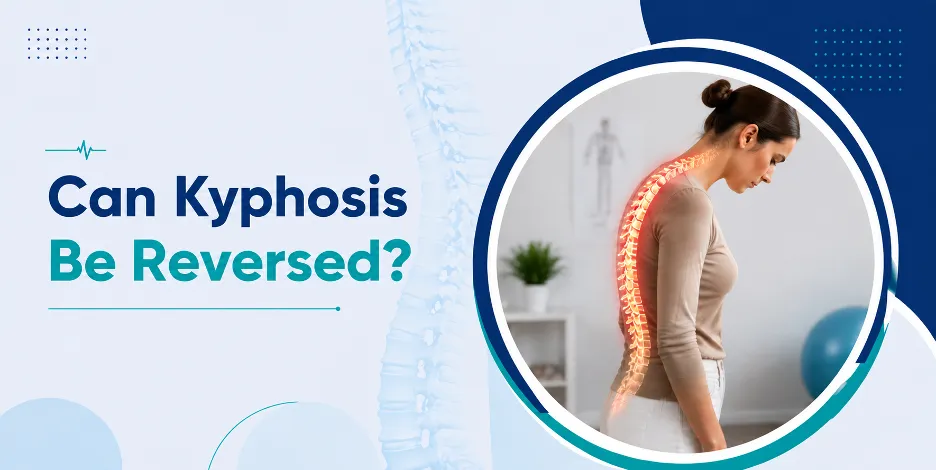
Kyphosis, the excessive forward curve of the upper spine that gives the back a rounded or “hunched” appearance, is one of the most common questions patients ask after diagnosis: can this actually be reversed, or is it something to simply live with? Dr. Naveen Tahasildar, a leading spine surgeon in Bangalore, explains that the honest answer depends entirely on the type of kyphosis, how rigid the curve has become, and how early it’s caught.
Some forms of kyphosis are fully correctable with posture training and exercise. Others, once the spine has finished growing or the vertebrae have structurally changed shape, cannot be reversed through non-surgical means alone, though they can still be effectively managed and, in severe cases, corrected surgically.
“Whether kyphosis can be reversed is really a question of flexibility versus rigidity. A flexible curve responds beautifully to physiotherapy. A rigid, structural curve needs a different conversation altogether.”
— Dr. Naveen Tahasildar, Spine Surgeon, Bangalore
Is Kyphosis Reversible? It Depends on the Type
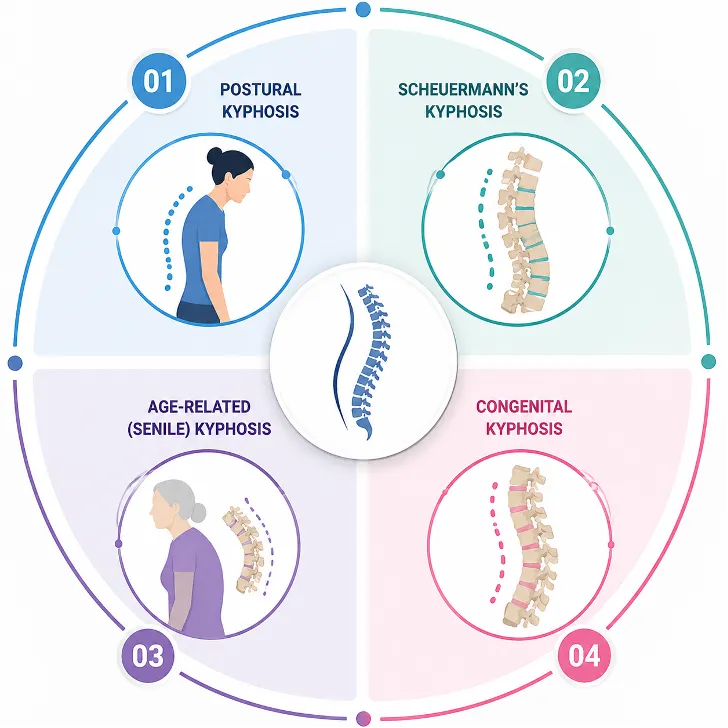
Kyphosis is not a single condition; it’s a category with distinct subtypes, and reversibility differs sharply between them.
Postural Kyphosis:
Fully Reversible: This is the most common and mildest form, caused by slouching, prolonged desk work, or weak back muscles. Because the vertebrae themselves remain normally shaped, postural kyphosis is flexible and responds well to posture correction, targeted physiotherapy, and consistent core and back strengthening.
Scheuermann’s Kyphosis:
Partially Reversible: A structural, rigid form that develops during adolescent growth, where the front of the vertebrae grow slower than the back, creating wedge-shaped bones. Once these bones have taken shape, the curve cannot fully reverse with posture alone, though early treatment during the growth years can meaningfully reduce or halt its progression.
Age-Related (Senile) Kyphosis:
Not Reversible, But Manageable: Caused by osteoporotic compression fractures that collapse the front of the vertebrae over time, this form generally cannot be reversed once the bone has collapsed. However, procedures like vertebral augmentation can restore some height and reduce further progression, alongside bone health treatment.
Congenital Kyphosis:
Structural From Birth: Present from birth due to malformed vertebrae, this type is structural by nature and does not respond to physiotherapy or bracing; it requires specialist monitoring and, in progressive cases, surgical correction.
What Determines Whether a Curve Can Be Reversed?
Understanding what makes a kyphotic curve correctable, or not, helps set realistic expectations early in the treatment journey.
Curve Flexibility:
A flexible curve straightens out, at least partially, when a patient actively extends their spine or lies down; a rigid curve does not change with position, signalling structural involvement.
Age and Growth Potential:
In growing children and teenagers, the spine has far more capacity to respond to correction than in adults whose bone growth has finished.
Curve Severity (Cobb Angle):
Curves under 40–45 degrees generally respond well to conservative treatment; curves that have progressed well beyond this threshold are far less likely to reverse without intervention.
Underlying Cause:
A curve driven by posture and muscle weakness behaves completely differently from one driven by vertebral wedging, fracture, or a congenital bone defect.
According to the Mayo Clinic, most cases of mild to moderate kyphosis do not require surgery and respond well to monitoring, exercise, and bracing when appropriate, reserving surgical correction for severe or symptomatic deformity.
How Reversal Is Approached at Each Stage
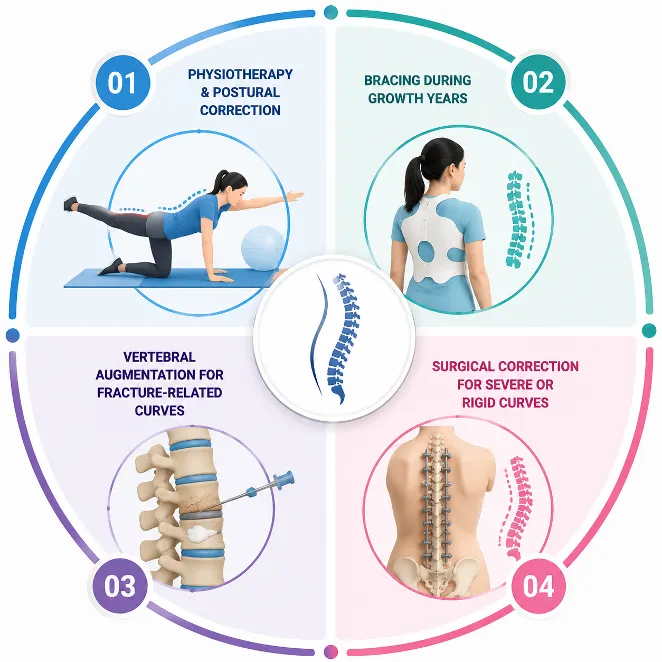
Treatment escalates only as far as necessary, always starting with the least invasive option that can still stop or reverse the curve.
Physiotherapy and Postural Correction:
For flexible, postural kyphosis, a structured programme targeting the back extensor muscles, core stability, and shoulder mobility is often enough to visibly reduce the curve over several months.
Bracing During Growth Years:
In Scheuermann’s kyphosis with an actively progressing curve, a customised brace worn consistently during the remaining growth years can significantly slow or halt progression. This follows similar principles to bracing for scoliosis.
Vertebral Augmentation for Fracture-Related Curves:
When osteoporotic compression fractures are driving the curve, restoring the collapsed vertebra directly can improve both pain and the developing deformity, alongside bone density management.
Surgical Correction for Severe or Rigid Curves:
When the curve is beyond correction through conservative means, or is causing nerve compression, breathing restriction, or unrelenting pain, surgical correction using spinal instrumentation restores alignment. Read more about how this is performed through scoliosis correction surgery.
Signs Your Kyphosis May No Longer Be Reversible
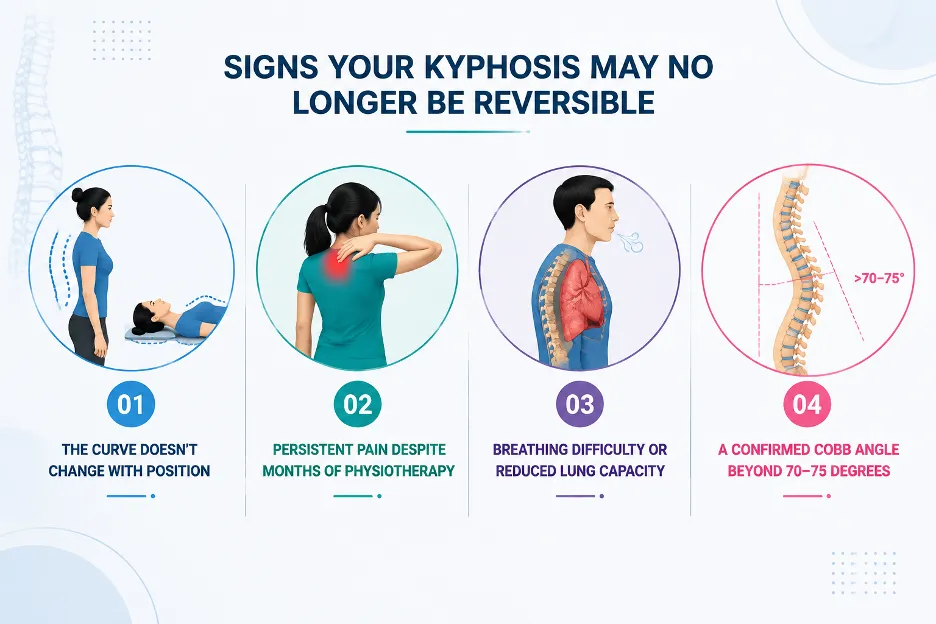
Certain signals suggest a curve has moved from flexible to structural, and that conservative measures alone are unlikely to reverse it.
The Curve Doesn’t Change With Position:
If the rounded back looks the same whether standing, lying flat, or actively trying to straighten up, the curve has likely become structurally rigid.
Persistent Pain Despite Months of Physiotherapy:
Pain and stiffness that don’t meaningfully improve after a genuine, consistent course of physiotherapy point toward a structural rather than postural cause.
Breathing Difficulty or Reduced Lung Capacity:
A significantly advanced curve can compress the chest cavity, a sign that the deformity has progressed well beyond what posture training can correct.
A Confirmed Cobb Angle Beyond 70–75 Degrees:
At this severity, or where there’s nerve compression, surgical correction becomes the option most likely to restore alignment and function. For select curve patterns at this stage, minimally invasive spine surgery can offer smaller incisions and a faster recovery.
How Dr. Naveen Tahasildar Assesses Reversibility
Dr. Naveen Tahasildar brings 18+ years of focused spine expertise and 4,000+ procedures performed across two Bangalore locations, using a step-wise, evidence-based approach that escalates treatment only when a less invasive option has genuinely been given a fair trial.
Assessment begins with standing X-rays to measure the exact curve angle and determine whether the deformity is flexible or rigid. MRI is used when nerve involvement or an underlying structural cause is suspected, and DEXA bone density scans are added for older patients to evaluate osteoporosis as a contributing factor. You can learn more about his training and fellowship background before your consultation.

“Patients often ask me for a yes or no answer on reversal, but the honest answer always starts with an X-ray. A flexible curve and a rigid curve look similar to the eye but behave completely differently under treatment.” — Dr. Naveen Tahasildar, Spine Surgeon, Bangalore
Conclusion
FAQs
1. Can postural kyphosis be fixed without surgery?
Yes. Postural kyphosis is flexible and typically responds very well to targeted physiotherapy, core strengthening, and posture correction over several months.
2. Can kyphosis in adults be reversed?
It depends on the cause. Adults with flexible, postural kyphosis can often improve significantly, while structural or fracture-related kyphosis is harder to fully reverse but can still be managed and, when needed, surgically corrected.