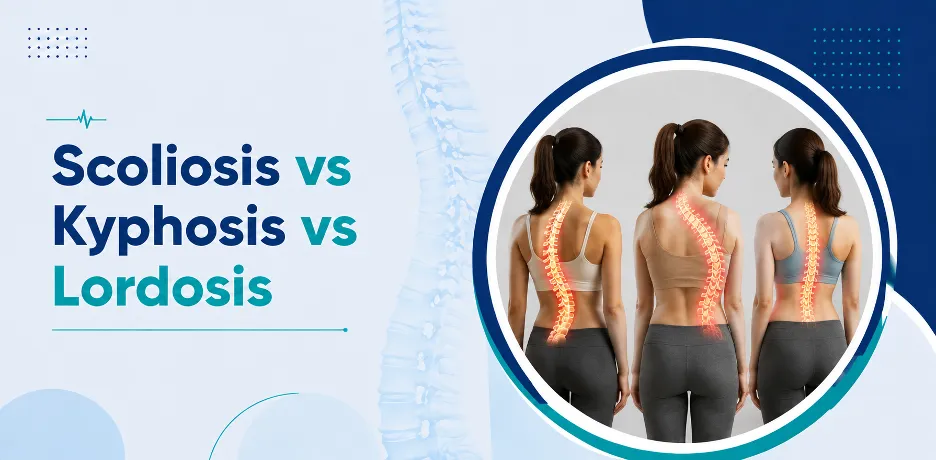
The spine has a natural curve built into it, gentle bends at the neck, upper back, and lower back that help absorb shock and keep the body balanced. But when these curves become exaggerated, or shift in a direction they shouldn’t, they’re given three different names: scoliosis, kyphosis, and lordosis. Dr. Naveen Tahasildar, a leading spine surgeon in Bangalore, explains that these terms are often used interchangeably by patients, even though they describe distinctly different deformities with different causes and treatment paths.
Understanding which condition you’re actually dealing with, and in which direction the spine is curving, is the first step toward getting the right treatment plan rather than a generic one.
“Patients often walk in saying ‘I have scoliosis’ when an X-ray shows kyphosis, or the reverse. The direction and location of the curve changes everything about how we approach treatment.”
— Dr. Naveen Tahasildar, Spine Surgeon, Bangalore
Not sure which spinal condition matches your symptoms or X-ray? Get a clear, accurate diagnosis before starting any treatment.
What Is Scoliosis?
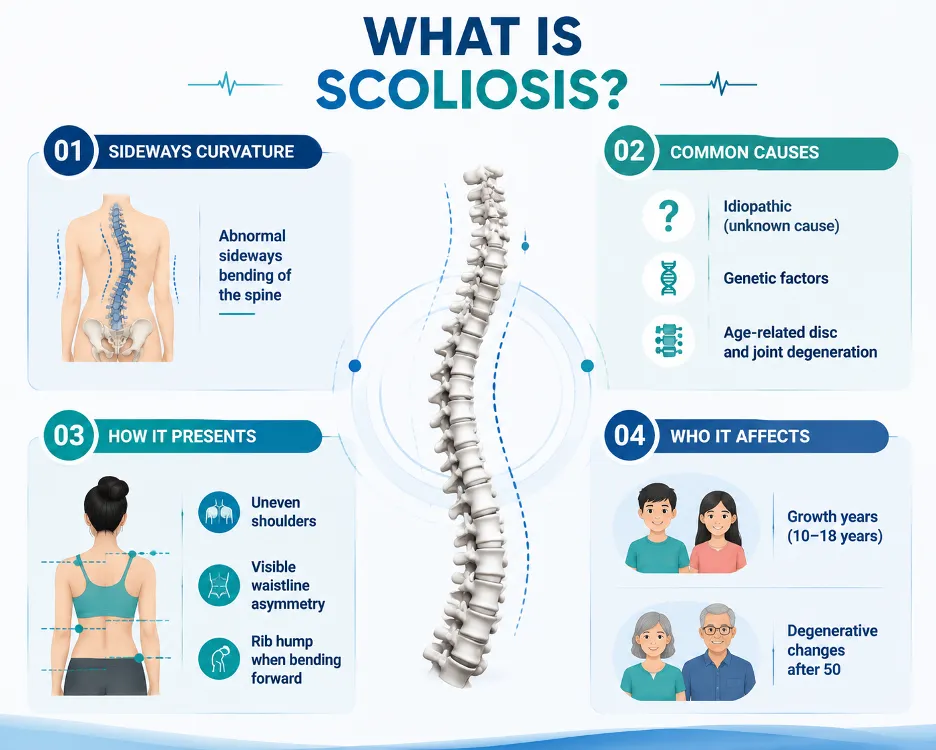
Scoliosis is a sideways (lateral) curvature of the spine, often forming an “S” or “C” shape when viewed from behind, rather than the front-to-back curves normal to the spine.
Common Causes:
Most cases in children and teenagers are idiopathic, meaning the exact cause is unknown, though genetics plays a strong role. Adult scoliosis often develops from age-related disc and joint degeneration.
How It Presents:
Uneven shoulders, a visible waistline asymmetry, one hip appearing higher than the other, or a rib hump when bending forward are the classic signs.
Who It Affects:
Idiopathic scoliosis typically appears during growth spurts between ages 10 and 18, while degenerative scoliosis usually develops after age 50.
What Is Kyphosis?
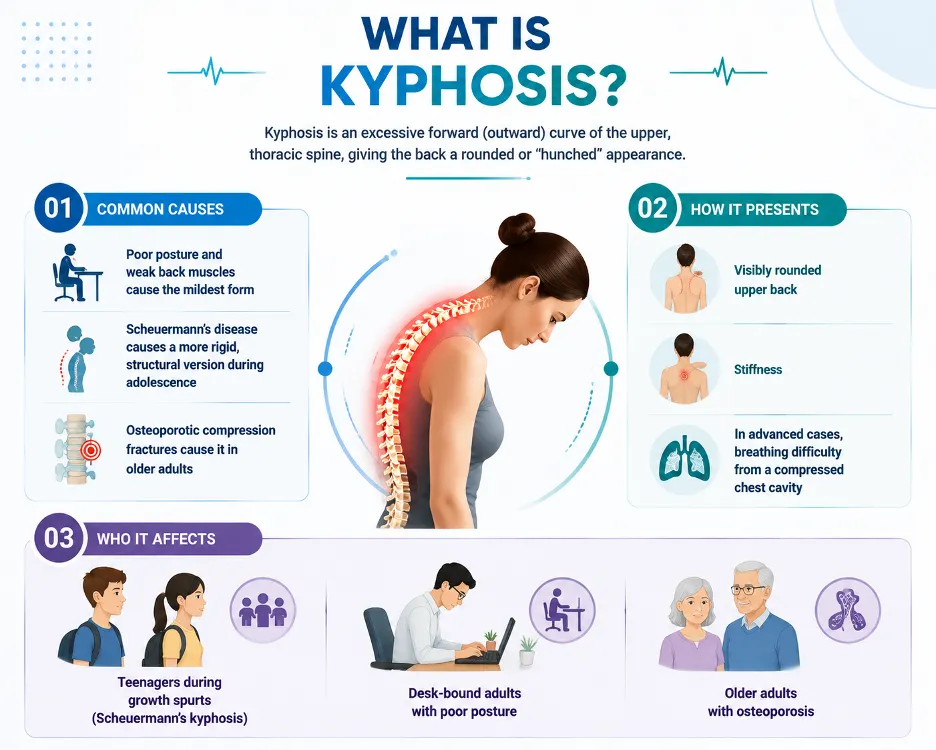
Kyphosis is an excessive forward (outward) curve of the upper, thoracic spine, giving the back a rounded or “hunched” appearance.
Common Causes:
Poor posture and weak back muscles cause the mildest form; Scheuermann’s disease causes a more rigid, structural version during adolescence; and osteoporotic compression fractures cause it in older adults.
How It Presents:
A visibly rounded upper back, stiffness, and in advanced cases, breathing difficulty from a compressed chest cavity.
Who It Affects:
Teenagers during growth spurts (Scheuermann’s kyphosis), desk-bound adults with poor posture, and older adults with osteoporosis.
What Is Lordosis?
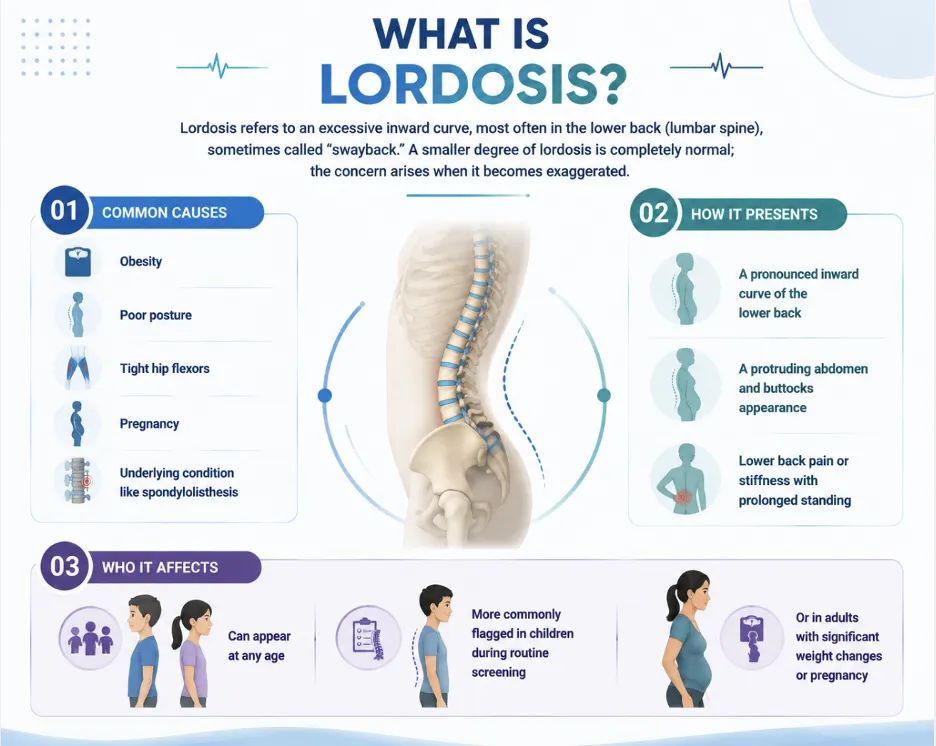
Lordosis refers to an excessive inward curve, most often in the lower back (lumbar spine), sometimes called “swayback.” A smaller degree of lordosis is completely normal; the concern arises when it becomes exaggerated.
Common Causes:
Obesity, poor posture, tight hip flexors, pregnancy, or an underlying condition like spondylolisthesis can all deepen this curve beyond a healthy range.
How It Presents:
A pronounced inward curve of the lower back, a protruding abdomen and buttocks appearance, and lower back pain or stiffness with prolonged standing.
Who It Affects:
It can appear at any age, though it’s more commonly flagged in children during routine screening or in adults with significant weight changes or pregnancy.
Scoliosis vs Kyphosis vs Lordosis: Key Differences
Seeing these three conditions side by side makes the distinction much clearer.
Direction of the Curve:
Scoliosis curves sideways; kyphosis curves excessively forward in the upper back; lordosis curves excessively inward in the lower back.
Spinal Region Most Affected:
Scoliosis can occur anywhere along the spine; kyphosis is centred in the thoracic (upper back) region; lordosis is centred in the lumbar (lower back) region.
Visible Sign:
Scoliosis shows as uneven shoulders or waist asymmetry; kyphosis shows as a rounded, hunched upper back; lordosis shows as an exaggerated inward curve and protruding abdomen.
Typical Onset:
Scoliosis often begins in adolescence or after age 50; kyphosis appears during growth spurts or with age-related bone changes; lordosis can develop at any age, often linked to weight or posture.
According to the Cleveland Clinic, these three spinal curve disorders are frequently confused by patients because all three can cause visible postural changes and back discomfort, even though the underlying mechanics differ substantially.
Can These Conditions Occur Together?
Yes, and this is more common than most patients expect. A person can have more than one of these curve abnormalities simultaneously, which is why an accurate, imaging-based diagnosis matters so much.
Kyphoscoliosis:
A combination of excessive forward curvature and sideways curvature, often seen in more complex or long-standing spinal deformities.
Compensatory Curves:
A pronounced kyphosis in the upper back can sometimes cause the lower back to develop compensatory excess lordosis, as the body tries to keep the head balanced over the pelvis.
Why Imaging Matters:
Standing X-rays that capture the full spine, not just the area of visible concern, are essential to correctly separate and measure each curve before deciding on treatment.
How These Conditions Are Diagnosed and Treated
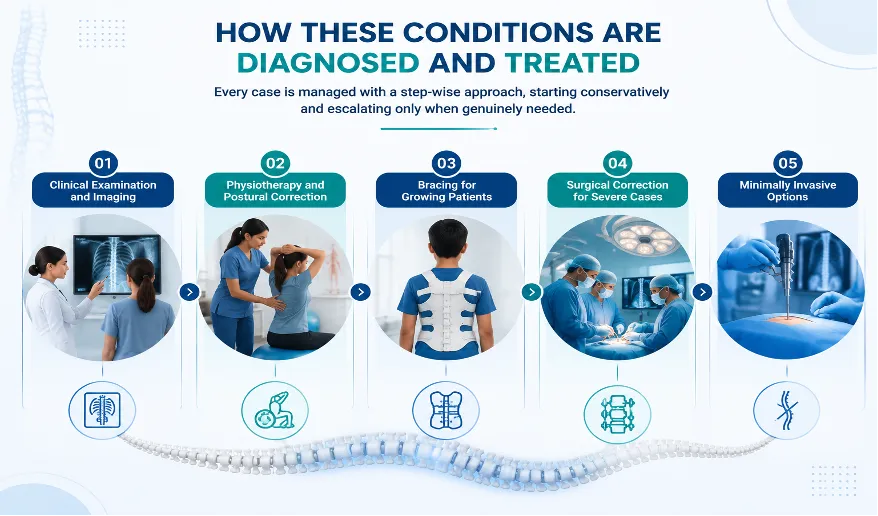
Every case is managed with a step-wise approach, starting conservatively and escalating only when genuinely needed.
Clinical Examination and Imaging:
Standing X-rays measure the exact curve angle, direction, and flexibility, distinguishing whether the deformity is scoliosis, kyphosis, lordosis, or a combination.
Physiotherapy and Postural Correction:
For flexible, mild curves in any of the three categories, targeted physiotherapy and core strengthening often produces measurable improvement over several months.
Bracing for Growing Patients:
For progressive curves in children and teenagers, a customised brace can significantly slow or halt worsening during the remaining growth years. Learn more about how this is approached through bracing for scoliosis.
Surgical Correction for Severe Cases:
When curves are severe, rigid, or causing nerve compression or breathing difficulty, surgical correction restores alignment and relieves pressure on the spinal cord and nerves. Read more about scoliosis correction surgery.
Minimally Invasive Options:
For select curve patterns, correction can also be approached through minimally invasive spine surgery, offering smaller incisions and a faster recovery.
Why Choose Dr. Naveen Tahasildar for Diagnosis and Treatment?
Dr. Naveen Tahasildar has spent over 18 years focused exclusively on spine care, with international fellowship training from Aarhus University Hospital, Denmark, and further specialisation in complex spinal deformity across scoliosis, kyphosis, and lordosis. He has performed 4,000+ spine procedures across Sparsh Hospitals, Infantry Road, and his clinic on Sarakki Road in Bangalore, bringing both surgical volume and a conservative-first philosophy to every consultation. You can learn more about his training and fellowship background before your visit.
His approach begins with correctly identifying which of the three curve types a patient actually has, since scoliosis, kyphosis, and lordosis are frequently confused even by patients who’ve already seen another doctor.
Only once the direction, severity, and flexibility of the curve are clear does he recommend a treatment path, always starting with the least invasive option that can still restore function.
“Correctly naming the curve is only the starting point. What actually guides treatment is whether it’s flexible or rigid, how severe it is, and how much growth potential remains.”
— Dr. Naveen Tahasildar, Spine Surgeon, Bangalore
Noticing an unusual curve, uneven shoulders, or persistent back pain? An accurate diagnosis is the first step toward the right treatment. Book An Appointment
Conclusion
Scoliosis, kyphosis, and lordosis all describe abnormal spinal curves, but they differ in direction, location, cause, and typical age of onset. Scoliosis bends sideways, kyphosis rounds the upper back forward, and lordosis exaggerates the lower back’s inward curve. Getting the diagnosis right through proper imaging is what determines whether physiotherapy, bracing, or surgical correction is the appropriate next step.
FAQs
1. Can you have scoliosis, kyphosis, and lordosis at the same time?
Yes. It’s possible to have more than one curve abnormality simultaneously, including combined conditions like kyphoscoliosis, which is why full-spine imaging is important for accurate diagnosis.
2. Which of the three conditions is most common?
Scoliosis and postural kyphosis are the most commonly diagnosed, particularly in adolescents during growth spurts, while significant lordosis is somewhat less frequently flagged as a standalone concern.
3. Do all three conditions require surgery?
No. Most mild to moderate cases across all three conditions respond well to physiotherapy, posture correction, or bracing. Surgery is reserved for severe, rigid, or symptomatic curves.
4. How can I tell which condition I have without a doctor?
You generally can’t reliably self-diagnose the exact type or severity, since all three can look similar on the surface. A clinical exam with standing X-rays is needed to measure and classify the curve accurately.
5. Are these conditions more common in children or adults?
Idiopathic scoliosis and Scheuermann’s kyphosis typically appear during adolescent growth spurts, while degenerative scoliosis, age-related kyphosis, and excess lordosis linked to weight or posture more often develop in adults.