
Every year, thousands of children are flagged during a routine school health check for something most parents have never had to think about: a curve in the spine. Dr. Naveen Tahasildar, a leading scoliosis and spine surgeon in Bangalore, explains that school scoliosis screening exists precisely because idiopathic scoliosis, the most common form, tends to develop quietly during a growth spurt, without pain and without anything visibly wrong to a parent watching from across the room.
A screening isn’t a diagnosis. It’s a filter, a quick, low-cost way to identify which children need a closer look from a specialist, and which don’t. Understanding what happens during that two-minute check, and what a “positive” result actually means, takes a lot of the panic out of the process.
“Parents often call me in a state of alarm after a school screening letter. The first thing I tell them is that a positive screen is a reason to get checked, not a reason to assume the worst. Most children who get referred to us turn out to have very mild, manageable curves.”
— Dr. Naveen Tahasildar, Spine Surgeon, Bangalore
What Is School Scoliosis Screening?
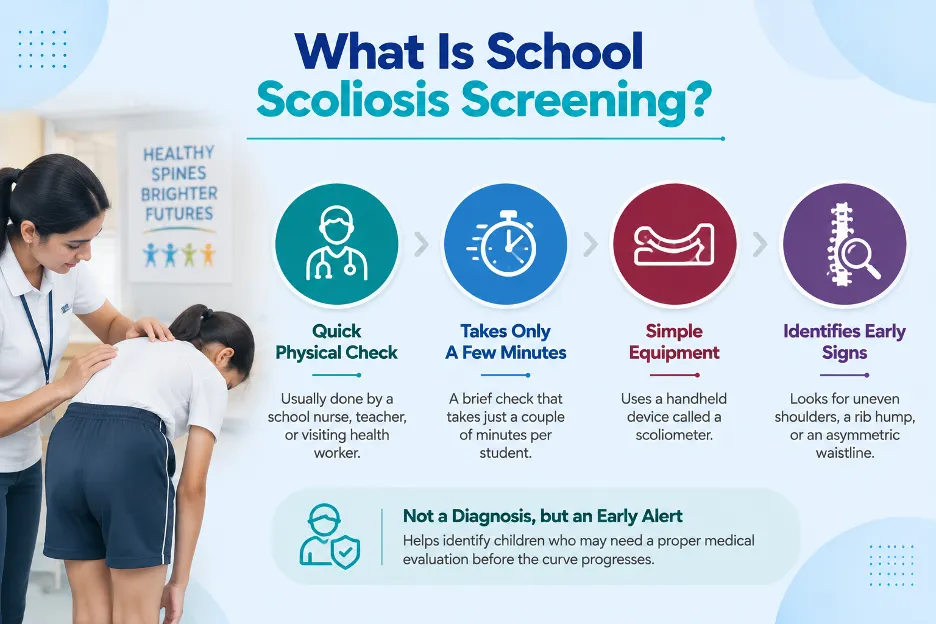
School scoliosis screening is a brief physical check, usually done by a school nurse, physical education teacher, or visiting health worker, to spot early signs of an abnormal spinal curve in growing children. It takes only a couple of minutes per student and doesn’t require any equipment beyond a simple handheld device called a scoliometer.
The idea isn’t to diagnose scoliosis at school. It’s to catch the children who show early physical signs of a curve, uneven shoulders, a rib hump, an asymmetric waistline, and route them toward a proper medical evaluation before the curve has a chance to progress unnoticed. Real examples of how early detection changes outcomes are shared in Dr. Naveen Tahasildar’s Case Study collection.
Why the Screening Age Matters
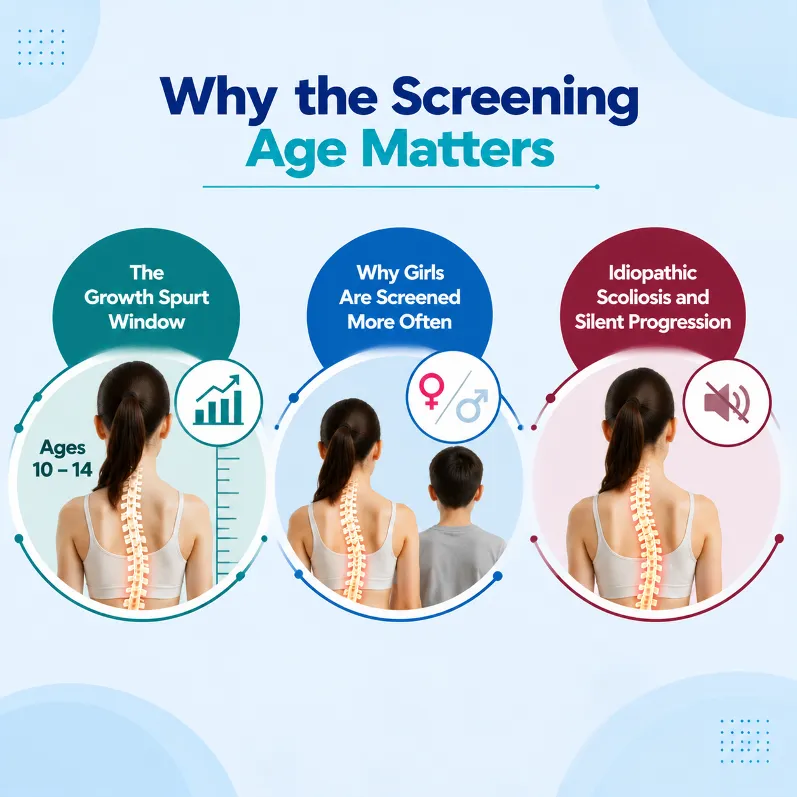
Timing is really the whole point of school-based screening, and it’s built around when idiopathic scoliosis is most likely to appear and progress.
The Growth Spurt Window:
Idiopathic scoliosis most commonly shows up and worsens during the rapid growth years of early adolescence, roughly ages 10 to 14. A curve that measures only 15 degrees at the start of a growth spurt can progress meaningfully within a matter of months if it goes undetected, which is exactly why screening is timed around this window rather than done once in early childhood.
Why Girls Are Screened
More Often Girls are screened more frequently than boys because they are several times more likely to develop a curve that progresses to the point of needing treatment. Joint clinical guidance from major orthopaedic and paediatric bodies has generally recommended screening girls twice, around ages 10 and 12, and screening boys once, around age 13 or 14.
Idiopathic Scoliosis and Silent Progression
The defining challenge with idiopathic scoliosis is that it usually doesn’t cause pain in its early stages. A child can have a 20 to 25 degree curve and feel completely fine, which is precisely why a physical screening check, rather than waiting for symptoms, is what catches it early.
What Actually Happens During a School Screening
The process is quick, non-invasive, and doesn’t involve any imaging at this stage.
The Forward Bend Test
The child is asked to bend forward at the waist with feet together and arms hanging down, palms together. The examiner looks along the back from behind for any asymmetry, one side of the rib cage sitting higher than the other, which suggests spinal rotation.
The Scoliometer Reading
If an asymmetry is visible, a scoliometer, a small inclinometer placed flat across the back, is used to measure the angle of trunk rotation at the highest point of the asymmetry. This number is what determines whether the child is referred for further evaluation.
What Counts as a “Positive” Screen:
Most school protocols use a scoliometer reading of around 5 to 7 degrees as the referral threshold. Crossing that threshold doesn’t confirm scoliosis; it simply means the child should have a proper clinical and possibly radiographic evaluation to find out.
Is School Screening Reliable? What the Evidence Actually Shows
This is where the picture gets a little more nuanced, and it’s worth understanding both sides.
The US Preventive Services Task Force has taken a more cautious position, concluding that current evidence is insufficient to fully weigh the benefits and harms of screening asymptomatic adolescents for idiopathic scoliosis in primary care settings. Their concern centres on the risk of over-referral and unnecessary anxiety for curves that would never have needed treatment anyway.
At the same time, a joint position statement from the Scoliosis Research Society, along with the Pediatric Orthopaedic Society of North America, the American Academy of Orthopaedic Surgeons, and the American Academy of Pediatrics, continues to support screening, pointing to the real-world benefit of catching curves early enough for bracing to work, before surgery becomes the only remaining option.
In practice, most Indian schools and paediatric practices lean toward screening precisely because early bracing is so much more effective than treatment started late. A false positive means an extra clinic visit. A missed curve can mean the difference between a brace and an operating table.
What to Do If Your Child's Screening Comes Back Positive
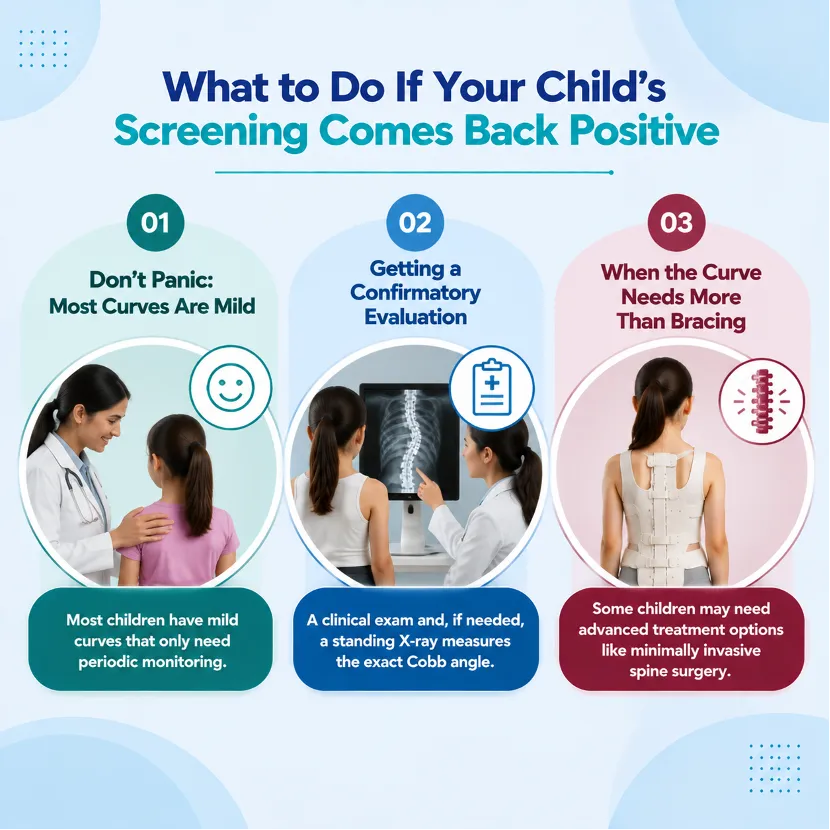
A positive screening result is common, and it is not, by itself, a diagnosis.
Don’t Panic:
Most Curves Are Mild The overwhelming majority of children referred after a school screening turn out to have curves well under 20 degrees, which typically just need periodic monitoring rather than any active treatment at all.
Getting a Confirmatory Evaluation:
The next step is a clinical examination and, if needed, a single standing X-ray to measure the exact Cobb angle. This is the only reliable way to move from “possible curve” to an actual number that a treatment decision can be based on. If a curve is significant enough to need a brace, it helps to know in advance what that involves, covered in more detail under Bracing for Scoliosis.
When the Curve Needs More Than Bracing:
A small proportion of children screened have curves that are already large or progressing quickly by the time they’re evaluated. For these cases, modern options such as Minimally Invasive Spine Surgery can mean a smaller incision and a faster return to school and sport than families often expect.
How These Conditions Are Diagnosed and Treated
Every case is managed with a step-wise approach, starting conservatively and escalating only when genuinely needed.
Clinical Examination and Imaging:
Standing X-rays measure the exact curve angle, direction, and flexibility, distinguishing whether the deformity is scoliosis, kyphosis, lordosis, or a combination.
Physiotherapy and Postural Correction:
For flexible, mild curves in any of the three categories, targeted physiotherapy and core strengthening often produces measurable improvement over several months.
Bracing for Growing Patients:
For progressive curves in children and teenagers, a customised brace can significantly slow or halt worsening during the remaining growth years. Learn more about how this is approached through bracing for scoliosis.
Surgical Correction for Severe Cases:
When curves are severe, rigid, or causing nerve compression or breathing difficulty, surgical correction restores alignment and relieves pressure on the spinal cord and nerves. Read more about scoliosis correction surgery.
Minimally Invasive Options:
For select curve patterns, correction can also be approached through minimally invasive spine surgery, offering smaller incisions and a faster recovery.
How Dr. Naveen Tahasildar Evaluates a Positive Screening Result
Dr. Naveen Tahasildar brings more than 18 years of dedicated spine experience and has performed over 100 scoliosis corrections at his Bangalore practice, with a philosophy built around escalating treatment only as far as the curve genuinely requires. You can read more about his training and fellowship background on the About Dr. Naveen Tahasildar page.
Evaluation begins with a detailed physical examination, repeating the forward bend test in clinical conditions and checking for shoulder, hip, and waist asymmetry. A standing X-ray follows to confirm the Cobb angle and determine the curve’s exact pattern. For children still early in their growth, bone age assessment helps estimate how much growth, and therefore how much potential progression, remains.

Most children evaluated this way are placed on a watch-and-monitor schedule, with a smaller group needing bracing and an even smaller number needing surgical correction.
“A screening letter from school is the start of a conversation, not the end of one. Nine times out of ten, that conversation ends with ‘let’s just keep an eye on this’ rather than anything more serious.”