
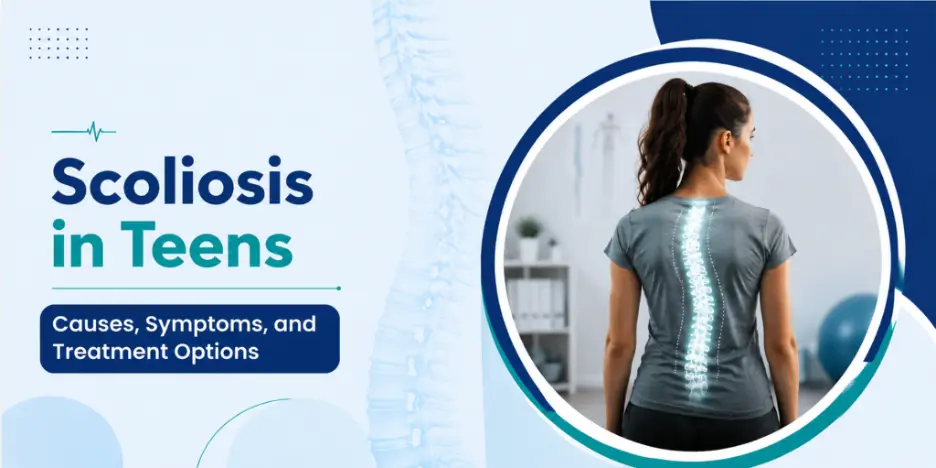
It usually starts small. A shirt that doesn’t hang quite right. A shoulder that sits a little higher in a school photo. A relative who casually asks, “why is her back like that?” More often than not, that’s how scoliosis in teens gets discovered, not through pain, but through a small, easy-to-miss physical clue.
If you’re a parent reading this because something similar just happened in your house, take a breath. Scoliosis is one of the most common spine conditions in growing children, and Dr. Naveen Tahasildar’s scoliosis programme for children and teenagers exists precisely because most families walking in worried leave with far more reassurance than they expected.
Adolescent idiopathic scoliosis, the type that shows up most often in teens typically develops during the growth spurt years between 10 and 18, and girls are affected more frequently than boys. “Idiopathic” simply means doctors don’t know the exact single cause, though genetics clearly plays a role. It sounds unsettling on paper. In practice, it’s a lot more manageable than most parents assume.
“Most teenagers with scoliosis never need surgery. What they need is timely evaluation, honest guidance, and consistent monitoring through the growth years. Fear usually comes from not knowing what to expect, not from the condition itself.” — Dr. Naveen Tahasildar, Spine and Scoliosis Surgeon, Bangalore
Worried about a curve you’ve noticed in your teenager? Book a consultation with Dr. Naveen Tahasildar and get a clear answer instead of months of uncertainty.
What Exactly Is Scoliosis in Teens?
Scoliosis is a sideways curve of the spine — instead of running straight down the back, it curves into an “S” or “C” shape when viewed from behind. In teenagers, the most common version is adolescent idiopathic scoliosis, which tends to appear without warning and progresses fastest during the years of rapid growth.
Doctors measure the curve in degrees using something called the Cobb angle, taken from a standing X-ray. As a rough guide: curves under 20 degrees are usually just watched, curves between 20 and 40 degrees often call for bracing, and larger curves may need surgical correction. The tricky part about teenage scoliosis is timing because growth can happen in bursts, a curve that looked stable three months ago can shift meaningfully by the next check-up. That’s why regular monitoring matters so much during this stage of life.
Why Does Scoliosis Show Up in Teenagers?
Nobody can point to one single cause of idiopathic scoliosis, but a few factors show up again and again in the research and in clinical practice.
It Tends to Run in Families
If a parent or sibling had scoliosis, a teenager’s odds of developing it go up. No single gene has been pinned down as “the” cause, but the hereditary pattern is hard to ignore.
Growth Spurts Speed Things Up
Curves progress fastest exactly when growth is fastest — right before and during puberty. This is the single biggest reason doctors want to see these patients more often during these years, not less.
Girls Are More Commonly Affected
Girls aren’t just more likely to develop scoliosis than boys, they’re also more likely to see it progress to a point where treatment becomes necessary.
Sometimes, There’s an Underlying Cause
Occasionally, scoliosis in teens is linked to a neuromuscular condition or a congenital spine difference that was present from birth but only became noticeable later. These cases usually need a different kind of monitoring than the more typical idiopathic form.
Signs Parents Should Actually Watch For
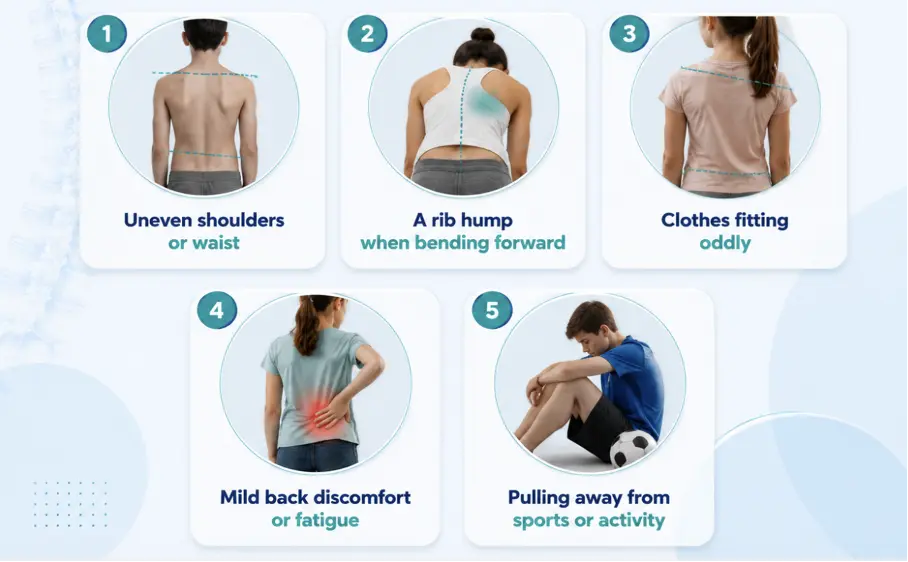
Here’s the frustrating part: early scoliosis usually doesn’t hurt. That’s exactly why it goes unnoticed for months, sometimes longer. Parents are almost always the first to catch it — not because of pain, but because of how it looks.
- Uneven shoulders or waist — one shoulder sitting higher, or an asymmetrical waistline while standing normally
- A rib hump when bending forward — one side of the back appears higher than the other, one of the clearest early signs
- Clothes fitting oddly — hemlines, waistbands, or straps that sit crooked for no obvious reason
- Mild back discomfort or fatigue — not universal, but worth mentioning to a doctor if it shows up
- Pulling away from sports or activity — sometimes tied to self-consciousness or discomfort a teenager hasn’t put into words yet
If two or three of these ring a bell, it’s worth getting checked. It doesn’t automatically mean treatment is needed, it just means it’s time to find out.
Still have questions about your teenager’s posture or spine? Book a consultation with Dr. Naveen Tahasildar and get answers you can actually act on.
How Doctors Actually Diagnose It
A proper workup combines a hands-on exam with imaging, and it’s less complicated than it sounds.
The forward bend test: It is usually step one — checking shoulder and waist symmetry while the teenager bends forward, which is often when a rib hump becomes visible.
A standing X-ray confirms the diagnosis and measures the exact curve using the Cobb angle, giving doctors a baseline to compare future scans against.
Growth and bone age assessment helps predict how the curve is likely to behave — since a curve in a teenager who’s nearly done growing behaves very differently from one in a teenager who’s just entering a growth spurt.
Families weighing their options can also read up on minimally invasive spine surgery to understand what that pathway looks like, in the rare case it becomes relevant.
What Treatment Actually Looks Like
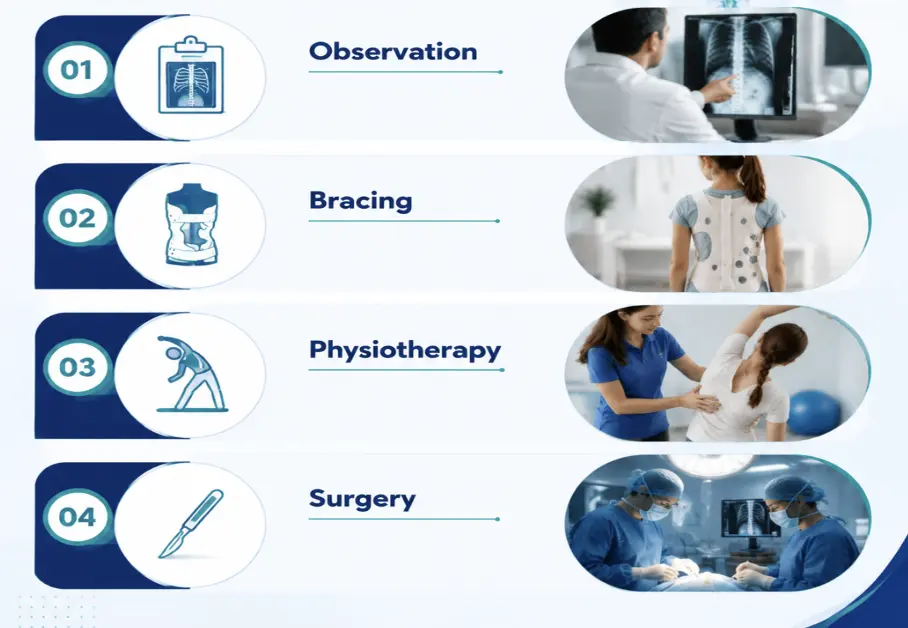
Treatment isn’t one-size-fits-all — it’s shaped by curve size, how much growing is left to do, and how the curve behaves over a few months of watching.
Observation: Mild curves, especially in teens nearing the end of their growth, are often simply tracked with X-rays every 4 to 6 months to confirm they’re staying put.
Bracing: Moderate curves in teens with real growing left to do often respond well to a custom-fitted brace. Done consistently, bracing can stop or slow a curve enough that surgery never enters the picture. You can read more about wear schedules and brace types as part of a full scoliosis treatment plan.
Physiotherapy: Scoliosis-specific physiotherapy, like the Schroth method, is often layered in alongside bracing or observation to build postural strength.
Surgery: Reserved for curves beyond roughly 45 to 50 degrees, or ones that keep progressing despite bracing. Modern techniques, including neuromonitored surgery, have made this a far safer option than most parents picture in their heads.
How Doctors Actually Diagnose It
A proper workup combines a hands-on exam with imaging, and it’s less complicated than it sounds.
The forward bend test: It is usually step one — checking shoulder and waist symmetry while the teenager bends forward, which is often when a rib hump becomes visible.
A standing X-ray confirms the diagnosis and measures the exact curve using the Cobb angle, giving doctors a baseline to compare future scans against.
Growth and bone age assessment helps predict how the curve is likely to behave — since a curve in a teenager who’s nearly done growing behaves very differently from one in a teenager who’s just entering a growth spurt.
Families weighing their options can also read up on minimally invasive spine surgery to understand what that pathway looks like, in the rare case it becomes relevant.
The Part Nobody Talks About: Living With It
Scoliosis isn’t just a spine measurement — for a teenager, it can quietly chip away at confidence, body image, and willingness to show up for gym class or a pool party, especially if a brace is involved. This is where honest, age-appropriate conversation matters as much as the medical plan. When teenagers understand why they’re wearing a brace or why a follow-up X-ray matters, they tend to stay engaged with their own treatment instead of feeling like it’s just happening to them.
The good news, and it’s worth repeating: the overwhelming majority of teenagers treated for scoliosis, whether through bracing or surgery, go on to live completely normal, active lives — full return to sports included, usually within months.
How Dr. Naveen Tahasildar Approaches Teen Scoliosis
Dr. Naveen Tahasildar has spent over 18 years focused specifically on spine and scoliosis care, performing 100+ scoliosis corrections while guiding many more teenagers through successful bracing and observation. His philosophy is conservative first: surgery only enters the conversation when observation, bracing, and physiotherapy genuinely aren’t enough to protect the spine. You can read more about his training and fellowship background on his spine surgeon profile, or see real patient journeys in his case studies.
“Every teenager’s curve tells a slightly different story. Our job is to read that story accurately through examination, imaging, and growth assessment — and then choose the least invasive path that still protects their spine for the decades ahead.” — Dr. Naveen Tahasildar

Noticed something that looks off in your teenager’s back or posture? Book a consultation with Dr. Naveen Tahasildar and get clarity, not just worry.
Frequently Asked Questions
1. At what age does scoliosis usually appear in teenagers?
2. Is scoliosis in teens painful?
3. Can scoliosis in teens get worse quickly?
4. Does every teenager with scoliosis need a brace or surgery?
5. Can teenagers with scoliosis still play sports?
References:
- Scoliosis Research Society — Adolescent Idiopathic Scoliosis;
- Cleveland Clinic — Scoliosis in Children and Teens.