
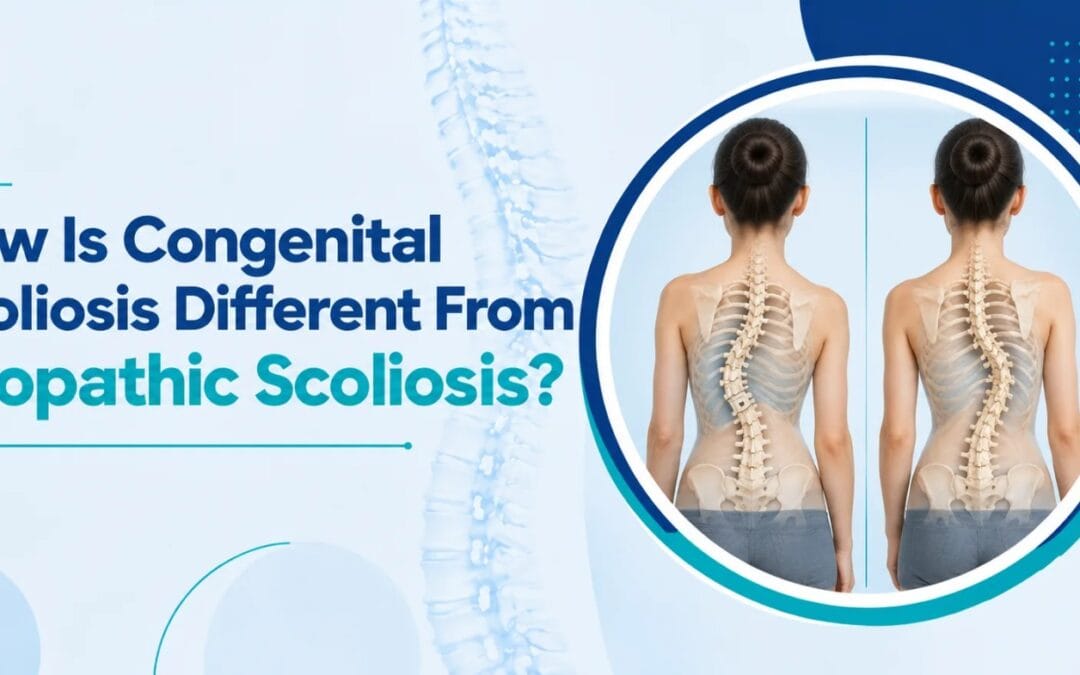
Not every spinal curve starts the same way. Congenital scoliosis traces back to how the spine formed before birth, while idiopathic scoliosis shows up later, usually during childhood or the teens, in a spine that developed normally. The type matters because it shapes when the curve gets caught and what treatment path makes sense.
According to Dr. Naveen Tahasildar, an expert in Scoliosis Treatment in Bangalore, “People tend to group these two together, but they don’t behave the same at all. Congenital cases are structural right from the start, we often catch them on prenatal scans or shortly after birth. Idiopathic ones show up later, often around a growth spurt, and honestly the cause still isn’t clear even after a full workup.”
Not sure which type of scoliosis your child has? Book an appointment and get a clear diagnosis.
What Causes Congenital Scoliosis Versus Idiopathic Scoliosis?
The two conditions split apart right at the source.
Congenital Scoliosis: This comes from vertebrae that didn’t fully form or fused incorrectly while the spine was developing in the womb. So it’s technically there at birth, even if nobody notices for years. Scans usually pick up wedge shaped or fused segments, sometimes alongside other organ related findings.
Idiopathic Scoliosis: Here there’s no birth defect involved at all. The curve just develops as the child grows, most often in the teenage years, with no single clear trigger behind it. It’s still the type doctors see most often.
Age of Detection: Congenital scoliosis can occasionally turn up on a prenatal ultrasound or a newborn exam. Idiopathic scoliosis usually gets noticed during a school screening or around age 10 to 15.
Associated Conditions: Kidney, heart, and spinal cord issues are more often associated with congenital scoliosis more often, so extra screening becomes standard. Idiopathic scoliosis mostly shows up on its own.
None of this gets figured out by guesswork, imaging does the real work here. That’s why congenital scoliosis treatment begins with a detailed structural workup rather than a standard growth chart.
How Does Treatment Differ Between the Two Types?
Once the type is confirmed, treatment planning follows a fairly different path for each.
Bracing tends to work reasonably well for idiopathic curves during growth. Congenital curves, being structural, usually don’t respond the same way to external bracing.
Timing matters too. Congenital scoliosis sometimes needs surgery earlier, occasionally before a major growth spurt, to keep severe deformity from setting in. Idiopathic cases are more often watched longer before surgery even comes up.
Monitoring Frequency: Congenital cases get tracked closely from infancy since progression can be unpredictable. Idiopathic cases follow a more routine schedule tied to growth stages.
Idiopathic scoliosis in growing kids comes with its own early warning signs. Our piece on scoliosis in teens walks through what parents usually notice first.
Why Choose Dr. Naveen Tahasildar for Congenital Scoliosis Treatment in Bangalore?
Dr. Naveen Tahasildar brings over 18 years of experience in spine surgery, backed by an MBBS, MS in Orthopaedics, and fellowships abroad in spine treatment. He favours the least invasive technique that can still resolve the problem, and turns to open surgery only when a smaller approach genuinely will not work.
Before anything gets decided, there’s detailed imaging and a proper clinical workup. Because here’s the thing, a congenital curve and an idiopathic one can look similar on the surface but need entirely different management. Treating both the same way just doesn’t hold up. Call +91 7676090119 to book your consultation.
FAQs
Can congenital scoliosis be detected before birth?
Sometimes, yes, on a prenatal ultrasound or shortly after delivery.
Is congenital scoliosis hereditary?
Usually not, it comes from how the spine developed in the womb.
Does congenital scoliosis always need surgery?
Not always, though it often needs closer monitoring and earlier action.
Can idiopathic scoliosis run in families?
Often, yes, there’s a genetic link even without a known exact cause.
References:
NIAMS, National Institutes of Health — Scoliosis Health Topic: https://www.niams.nih.gov/health-topics/scoliosis
Weinstein SL, et al. — Effects of Bracing in Adolescents with Idiopathic Scoliosis, PubMed: https://pubmed.ncbi.nlm.nih.gov/24047455/
Disclaimer:This blog is for general educational purposes only and does not replace a professional diagnosis or imaging review. Consult a spine specialist for an accurate assessment.